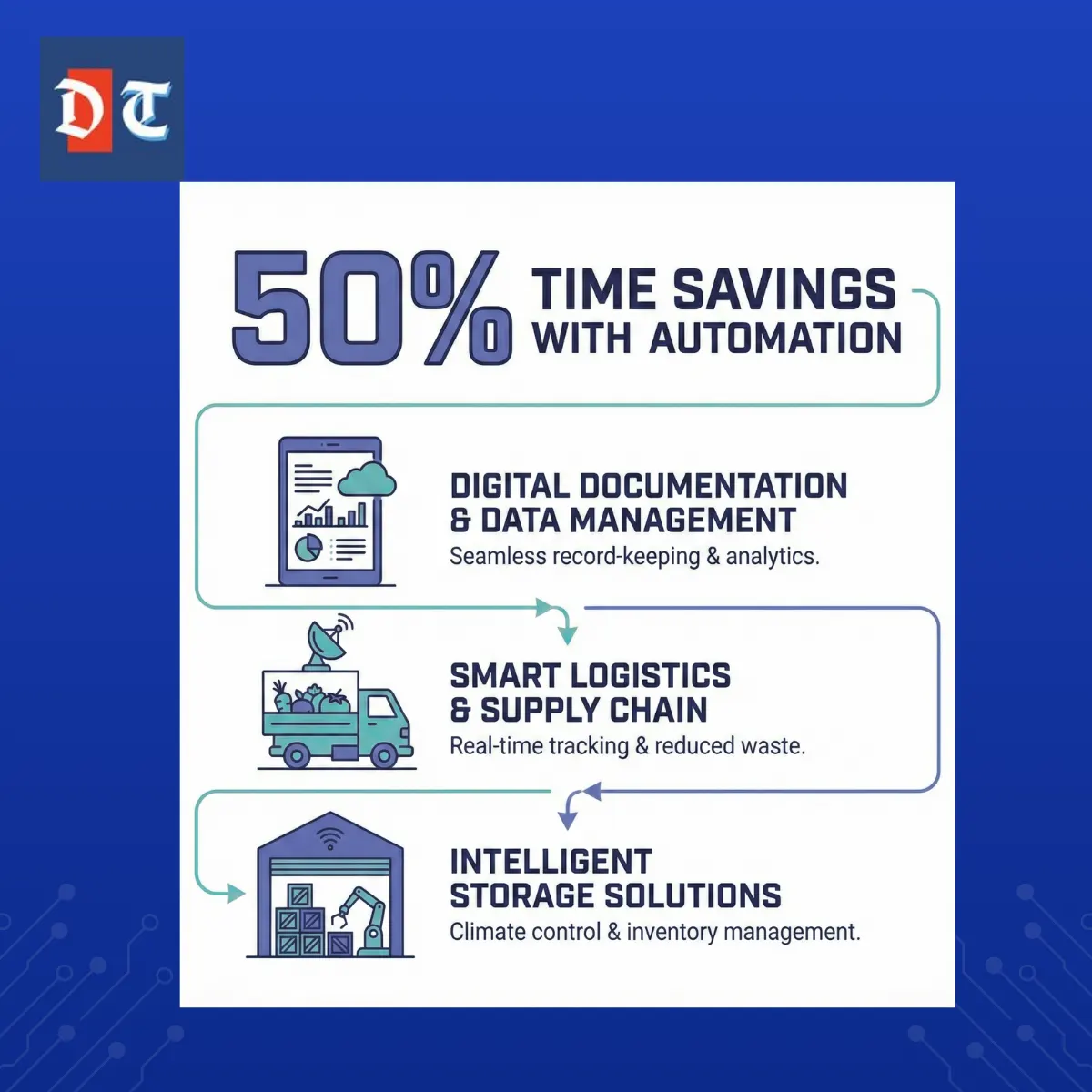
From challenges to measurable benefits: a case study
Modern agriculture, under pressure from global markets, changing regulations and a shifting natural environment, increasingly looks for a competitive edge in precision, optimisation and digitisation. It is no longer about “having” technology, but about using it strategically to transform operations at their core.
This case study looks at a rollout project for one of the leaders of the agri sector. We show how comprehensive IT solutions became the catalyst for change — redefining business processes and delivering hard, countable data.
Project context: understanding the agri domain
Every innovative rollout starts with a thorough understanding of the industry. In agriculture that means dealing with seasonal operations, a complex supply chain (from seed to distribution) and strict certification standards.
Our client was facing the typical problems of growth: fragmented systems, paper-based document flow and no “single source of truth” about its processes. These pain points generated significant operating costs and a risk of human error. The strategic goal became full consolidation and digitisation of processes within 24 months.
Solution architecture: the foundations of the transformation
Architectural decisions are the backbone of a system. In this project we chose a hybrid approach, combining proven Microsoft technologies with the flexibility of the cloud and openness to integration.
Frontend: intuitive under tough conditions
Challenge: responsive interfaces for a very mixed group of users — from office staff to drivers and suppliers working in the field. Solution: the Angular framework, which gave us modularity and high performance for large business applications. A key focus was UX/UI, which drastically shortened onboarding for less digitally confident employees.
Backend: an efficient operational engine
Challenge: a stable API able to handle mass registrations and the transaction peaks typical of the harvest season. Solution: an implementation based on .NET Core. A microservice architecture made testing easy and kept the system reliable under heavy load.
Data layer: hybrid persistence
Solution: we took a distinctive “best of breed” approach — MySQL for flexible transactional and analytical data, and MSSQL for data that demands the highest integrity and complex relationships (finance, certification). This struck the right balance between cost and query performance.
Integrations and cloud: scaling without limits
The system runs in Microsoft Azure, using containerisation (Docker) and orchestration (Kubernetes). Resources scale automatically — the system “grows” during the season and “shrinks” after it, optimising infrastructure costs. We extended its functionality with dedicated integration microservices:
- Google Maps API — for advanced optimisation of logistics routes.
- Autenti — for a fully digital contract-signing process.
Key modules and measurable results (ROI)
This is not theory — it is practice. Here is how each module translated into business results.
Digital registration for training and field days
- Challenge: chaotic, manual registration and no consistent database of participants.
- Solution: a central web application for running events.
- RESULT: reception handling time cut by 50% and errors in participants’ contact details eliminated.
Document automation (integration with Autenti)
- Challenge: a costly, slow flow of paper contracts.
- Solution: a generator of document packages with electronic signatures.
- RESULT: the contract-signing cycle shortened from 7 days to an average of 4 hours, and operating costs (paper, couriers) reduced by an estimated 30%.
Certification and the loyalty programme
- Challenge: difficulty verifying whether suppliers’ certificates were valid.
- Solution: a digital certificate lifecycle.
- RESULT: 100% compliance with audit standards and automated payment of loyalty bonuses.
Warehouse Intelligence
- Challenge: no precise knowledge of where goods were located.
- Solution: warehouse visualisation and real-time transaction tracking.
- RESULT: warehouse space used 15% more efficiently and shorter stocktaking.
Logistics and transport
- Challenge: inefficient routes and no control over delivery notifications.
- Solution: algorithmic route optimisation using Google Maps.
- RESULT: fewer empty runs and fleet fuel costs down by around 10–12% a year.
Summary: a lesson in digital transformation
This rollout proves that technology in agriculture is not an add-on but a driver of profit. The key to success was not the code itself, but goal-driven architecture and a close business partnership.
The conclusion is clear: automating a process is not enough — you have to measure the results. Choosing .NET Core, Angular and Azure was the means to an end: scalability and security. This case study confirms that a well-thought-out IT strategy is essential for the future of sectors as dynamic as agriculture.